
OSNet

OSNet

Algorithm

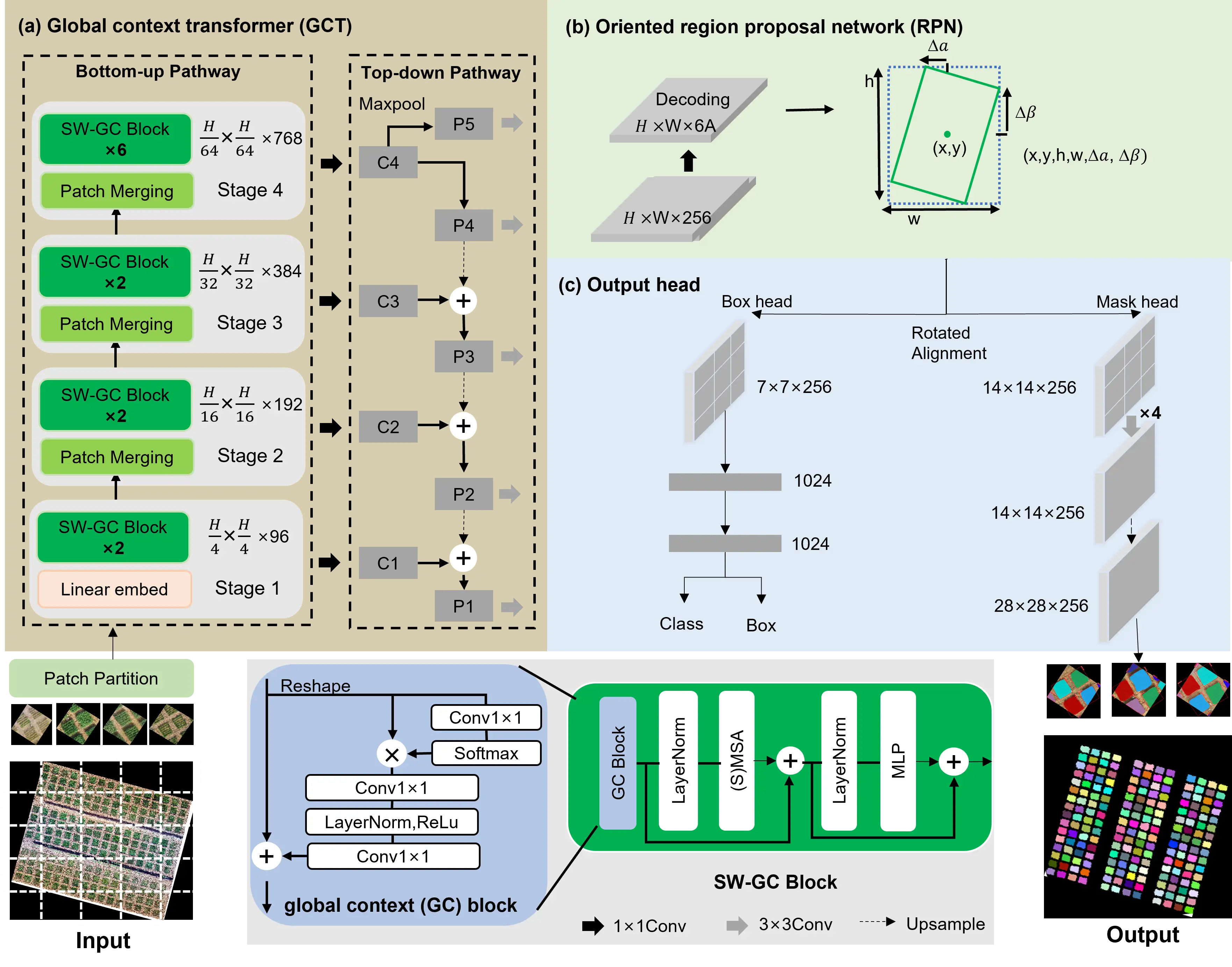
The OSNet comprises three key components. (1) To solve the low accuracy caused by ambiguous gaps within and between plots and color similarity due to it efficiently fusing global information, the global context transformer (GCT) works as the backbone for better extracting multi-scale features from the RGB image patches. (2) To solve the feature misalignment caused by arbitrary-orientated plots, as it encompasses the entire rotation object, the Oriented Region Proposal Network (RPN) utilizes the multi-scale features to generate oriented region proposals. (3) The Output head consists of a rotated alignment module, a Box head branch, and a Mask head branch. The Box head branch takes a set of oriented proposals as input and outputs their class probability and offsets to achieve plot detection. The Mask head branch produces the instance segmentation mask for each plot.

SOTA Performance

0.917

AP@0.5

0.985

Precision

0.934

Recall

0.959

F1-score

0.966

Accuracy

0.912

IoU

Transferability

Explore more

OSNet can be transferred across different years (i.e., RealWheat2023 dataset), different crop data (i.e., RealRice2023 dataset), and various data dimensions (i.e., VirtualWheat dataset) through transfer learning strategies. OSNet achieved relatively higher accuracy through the two-step than w/o and one-step transfer strategies. OSNet not only achieved high initial accuracy but also facilitated faster convergence during training on the new dataset through transfer learning strategies. The two-step method required fewer iterations for convergence and achieved a lower training loss value than the w/o transfer and the one-step method. Moreover, transfer learning enabled OSNet to achieve high segmentation accuracy on the validation dataset, and the two-step method outperformed others.

Applicability

Accelerate phenotyping

Segmenting individual breeding plots from UAV images is the prerequisite for extracting plot-level phenotypic traits. OSNet can potentially enhance the breeding plot segmentation efficiency, consequently boosting crop phenotypic trait extraction from various typical data sources. This study introduced OSNet as the core to construct two pipelines for rapidly extracting key phenotypic traits: wheat spike detection and canopy height measurement.

Citation

If you find this work useful for your research, please consider citing our paper:

@article{zhang2025osnet,
  title={OSNet: an oriented instance segmentation network of breeding plot extraction from UAV RGB imagery},
  author={Zhang, Ruinan and Zhang, Yuanhao and Jin, Shichao and Zang, Jingrong and Zhao, Ruofan and Yao, Jiaqi and Li, Shaochen and Li, Qing and Su, Yanjun and Wu, Jin and others},
  journal={Computers and Electronics in Agriculture},
  volume={236},
  pages={110436},
  year={2025},
  publisher={Elsevier}
}